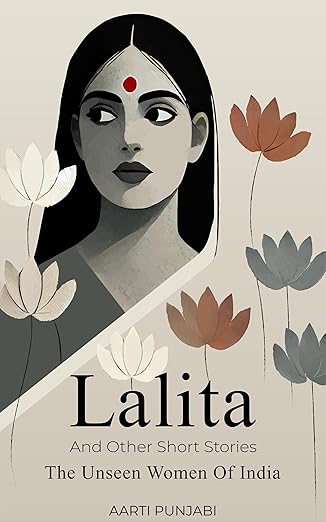
Lalita and Other Short Stories: The Unseen Women Of India by Aarti Punjabi
My take on the book:
Lalita and other short stories is a collection of ten short stories each named after the woman character the story revolves around.
Lalita is about a young woman whose husband working in the Indian army in the Siachen area went missing a few days after their marriage and how Lalita’s life is affected and how she processes this grief.
Jahnvi is about a teenage girl who works as her mother’s replacement as a house help, and when she faces abuse at work and is advised about using #MeToo will Jahnvi be able to report the abuse or does it work only for the privileged?
Baanu is about a eighty-seven-year old lady who lived alone after her husband passed away and is at the mercy of her niece Freny who taunted Baanu more and cared less for her. What fortune does Baanu have that will keep Freny invested in Baanu’s well-being?
Priya is about a middle-aged-woman who recently developed a friends’ circle of rich friends and when Priya wants to match her other friend’s lifestyle, her mother-in-law has reservations. Ironically her father-in-law has a similar opinion about her mother-in-law Shobha’s expenses.
Indu is a twenty-nine-year old woman who seems to be crossing her marriageable age much to the panic of her single mother who is worried about finding a match for Indu. Indu has to decide between a silent admirer at work versus loveless arranged marriage.
Mrs. Saxena is about Mr. and Mrs. Saxena, how their lives changed over the years with Mr. Saxena being very particular about his daily timetable and Mrs. Saxena nonchalant towards it.
Geeta Bua is a child-less widow who is looked after by her extended family but that meant she went and stayed with each family for a few months and mostly they invited her over when they needed her help. Geeta bua had the most tricky situation when two families wanted her presence at the same time and refusing to visit either of them meant permanently facing their wrath.
Bhavna is getting ready to marry her sweetheart Vikas in five weeks but Vikas and his family wanted Bhavna to change her name after marriage. Bhavna who always hated her name jumped at this opportunity to pick a new name for herself, her younger sister Reena hated this whole name-changing exercise.
Laajo is thankful to her elder sister for all her help and support through the years and as a token of gratitude invites a prospective groom for her Didi’s daughter Chando. After meeting the boy’s family will Didi be grateful to Laajo or will Laajo’s arrogance be revealed?
Tara is the daughter of Chanda, who is from a backward caste and earned a living by cleaning houses and bathrooms in her locality. Chanda is treated as an untouchable by the women who employed her, so did the other house helpers who behaved like they were superior to Chanda. When Tara suddenly gets married, Tara reminds everyone whether money or caste is of more significance in this society.
All the stories have a female protagonist and interestingly the other characters with negative shades also are mostly women. All stories are set up in simple and relatable backdrops. Most characters feel like the ones we met at some point in our life, in our extended family, in our neighbourhood or at our workplace. The issues addressed by the author in the stories are also very relatable, most are the ones we experience in our daily life but may ignore them instead of addressing them.
Lalita’s story speaks about society’s expectations of grief for women, Jahnvi’s about abuse being pushed aside instead of punishing the perpetrators, Baanu’s story raises the question around surviving old age at the mercy of selfish relatives, Priya’s story is about family members imposing rules for the younger ones without realising they are also committing the same mistakes. Indu’s story highlights the harsh reality of arranged marriages in our society as a girl’s marriage is often seen as a burden by the parents and most men look at their wives as free maids for their mothers.
Tara signifies the current generation of kids who do not accept inferior treatment based on their caste or social standing. Laajo highlights the difference between gratitude and arrogance. Geeta Bua is the most heart wrenching story among all the stories, as child-less widows who are, like Baanu, looked after by relatives only when it is beneficial for them.
While the author raises some important questions about our society and how women are treated in different situations and circumstances, few among the ten stories leave an impact, and others feel under-developed. I think short stories are normally concluded without a proper ending by authors, mostly to leave it to the reader’s imagination and the same works in favour of few stories while others felt incomplete.
With simple stories that leave a good impact on the reader, Lalita and Other Stories makes for a good one time read.
My rating:
3.5/5.
This review is part of the Blogchatter Book Review Program